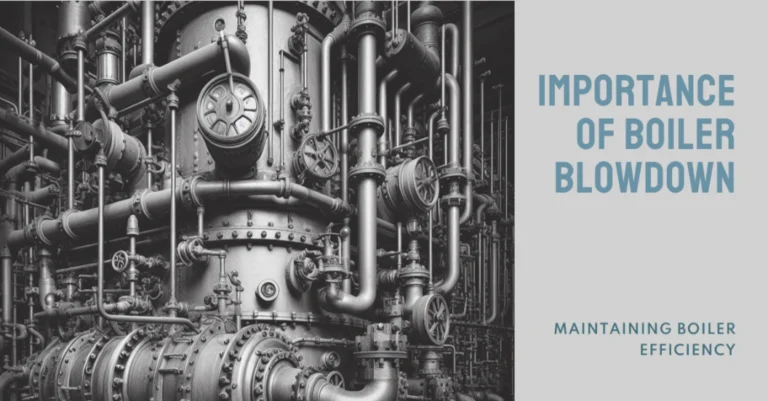
Bottom blowdown in a boiler is the process of safely removing accumulated sludge and sediment from the bottom of the boiler by periodically opening valves in the mud drum, allowing the boiler pressure to force them out. This essential maintenance procedure prevents the buildup of sludge and solids in the boiler, ensuring optimal performance and efficiency.
What is Bottom Blowdown in a Boiler?
Bottom blowdown is the process of removing water containing sludge, sediment, and other suspended impurities that settle at the bottom of a boiler. This operation is essential for maintaining boiler efficiency, preventing damage, and ensuring safe operation. Bottom blowdown is typically conducted manually or using automated systems, depending on the boiler’s design and operational requirements.
Key Features of Bottom Blowdown:
- Location: Performed at the bottom of the boiler drum, where heavier impurities accumulate.
- Purpose: Removes sludge, sediment, and other particulates to prevent scaling and damage to the boiler surfaces.
- Intermittent Operation: Usually conducted at scheduled intervals, as opposed to continuous surface blowdown.
Why is Bottom Blowdown Important?
- Prevents Scale Formation: Sludge and sediments can adhere to heating surfaces, reducing heat transfer efficiency and increasing fuel consumption.
- Minimizes Corrosion: Accumulated impurities can create corrosive conditions, damaging the boiler over time.
- Ensures Steam Quality: Prevents carryover of impurities into the steam, protecting downstream equipment and processes.
- Maintains Boiler Capacity: Prevents clogging and loss of effective water volume within the boiler.
Essential Guide to Bottom Blowdown
1. Determine Blowdown Frequency
- Establish a schedule based on boiler load, feedwater quality, and the concentration of impurities.
- High-impurity feedwater requires more frequent blowdowns.
2. Follow Proper Procedures
- Open the blowdown valve gradually to avoid pressure surges.
- Limit blowdown duration to avoid excessive water and energy losses.
- Ensure valves are securely closed after the operation to prevent leaks.
3. Use Blowdown Tanks
- Discharged water should pass through a blowdown tank to safely reduce pressure and temperature before disposal.
- This ensures compliance with environmental and safety regulations.
4. Install Heat Recovery Systems
- Recover heat from blowdown water to preheat feedwater, improving boiler efficiency and reducing energy costs.
5. Monitor Water Chemistry
- Use chemical treatment and regular testing to control the concentration of suspended solids in the boiler water.
6. Maintain Equipment
- Regularly inspect and maintain blowdown valves, tanks, and pipelines to prevent operational issues.
7. Ensure Operator Training
- Train boiler operators on proper bottom blowdown techniques, emphasizing safety precautions and efficiency.
8. Adhere to Manufacturer Guidelines
- Follow the boiler manufacturer’s recommendations for blowdown frequency, volume, and procedures.
By conducting bottom blowdown effectively, boiler operators can maintain optimal performance, reduce operating costs, and extend the lifespan of the equipment.
FAQ’s For What Is Bottom Blowdown In Boiler?
What Are The Two Types Of Boiler Blowdown?
The two types of boiler blowdown are bottom blowdown and surface blowdown. Bottom blowdown occurs at the bottom of the boiler, where sludge and sediment accumulate. Surface blowdown happens near the surface of the boiler, where the concentration of dissolved solids is highest.
How Often Should A Water Column Be Blown Down?
The water column should be blown down once a shift to reduce the concentration of suspended and dissolved solids in the water.
What Is The Purpose Of A Blowdown Vessel?
The purpose of a blowdown vessel is to safely store and cool the water that is discharged from a steam boiler during the blowdown process. This helps reduce the concentration of suspended and dissolved solids in the water before it is discarded to drain.
What Is Bottom Blowdown In A Boiler?
Bottom blowdown is a process in which valves in the mud drum of a boiler are opened to release accumulated sludge and sediment at the bottom. This helps to maintain the cleanliness and efficiency of the boiler by removing impurities and preventing the buildup of solids.
Referencres:
- “Avoiding Boiler Problems.” William L. Reeves. ASHRAE Journal. September 2001 Issue.
- “Boiler Blowdown Energy Recovery.” Greg Harrell. Energy Matters Newsletter. Winter 2003 Issue.
Department of Energy. Industrial Technologies Program. 2003. - Boiler Efficiency Improvement. David F. Dyer and Glennon Maples. Fifth Edition. Auburn University.
Boiler Efficiency Institute. Auburn, Ala. 1991. - “Best Practices – Steam Generation.” Utah Industries of the Future.
- “Install an Automatic Blowdown Control System.” Steam Tip Sheet #23. Department of Energy. Industrial
Technologies Program. April 2004. - “Minimizing Boiler Blowdown.” Steam Tip Sheet #9. Department of Energy. Office of Industrial
Technologies. Energy Efficiency and Renewable Energy. June 2001.